Mintbrooks may earn a commission from purchases made through links in this article.
Achieving truly aesthetic shelf decor doesn't rely on innate talent. It follows a simple, repeatable formula: the 3-2-1 rule. This designer-backed method ensures balance, visual interest, and a curated feel, transforming cluttered shelves into stylish displays.
Understanding the 3-2-1 Rule for Aesthetic Shelf Decor
The 3-2-1 rule is a straightforward framework for styling any shelf or bookcase. It breaks down the process into three core components: three types of objects, two distinct heights, and one commanding focal point per styled section. This rule creates visual harmony and prevents your shelves from looking either sparse or overly cluttered. It's the secret behind those effortlessly chic displays you admire in magazines and showrooms.
This method works because it addresses the core principles of good design: variety, balance, and hierarchy. By consciously choosing items that fit these categories, you ensure your aesthetic shelf decor feels intentional and cohesive. You're not just placing objects; you're composing a vignette.
"Good design is about intention, not accident. The 3-2-1 rule gives you that intention for every shelf."
The "3" Types of Objects: Variety is Key
When curating your aesthetic shelf decor, select three distinct categories of items. This variety adds depth and interest, preventing a monotonous display. Think of these as your building blocks. Here are the categories designers consistently use:
- Books: Essential for warmth, texture, and a sense of personality. Use them both vertically and horizontally. For vertical stacks, consider a grouping of 3-5 books. For horizontal stacks, 2-3 books can act as a pedestal for a smaller object. Opt for books with appealing covers or remove dust jackets for a more neutral, textural look. Examples include art books like "Art & Fear" by David Bayles and Ted Orland, or classic literature with attractive bindings.
- Sculptural/Decorative Objects: These are your "pretty" pieces. They add personality, shape, and often a touch of luxury. Think vases, small sculptures, candles, or decorative boxes. Consider materials like ceramic, brass, wood, or glass to add textural contrast. A small, handcrafted vase from Etsy or a brass knot sculpture from CB2 are excellent choices.
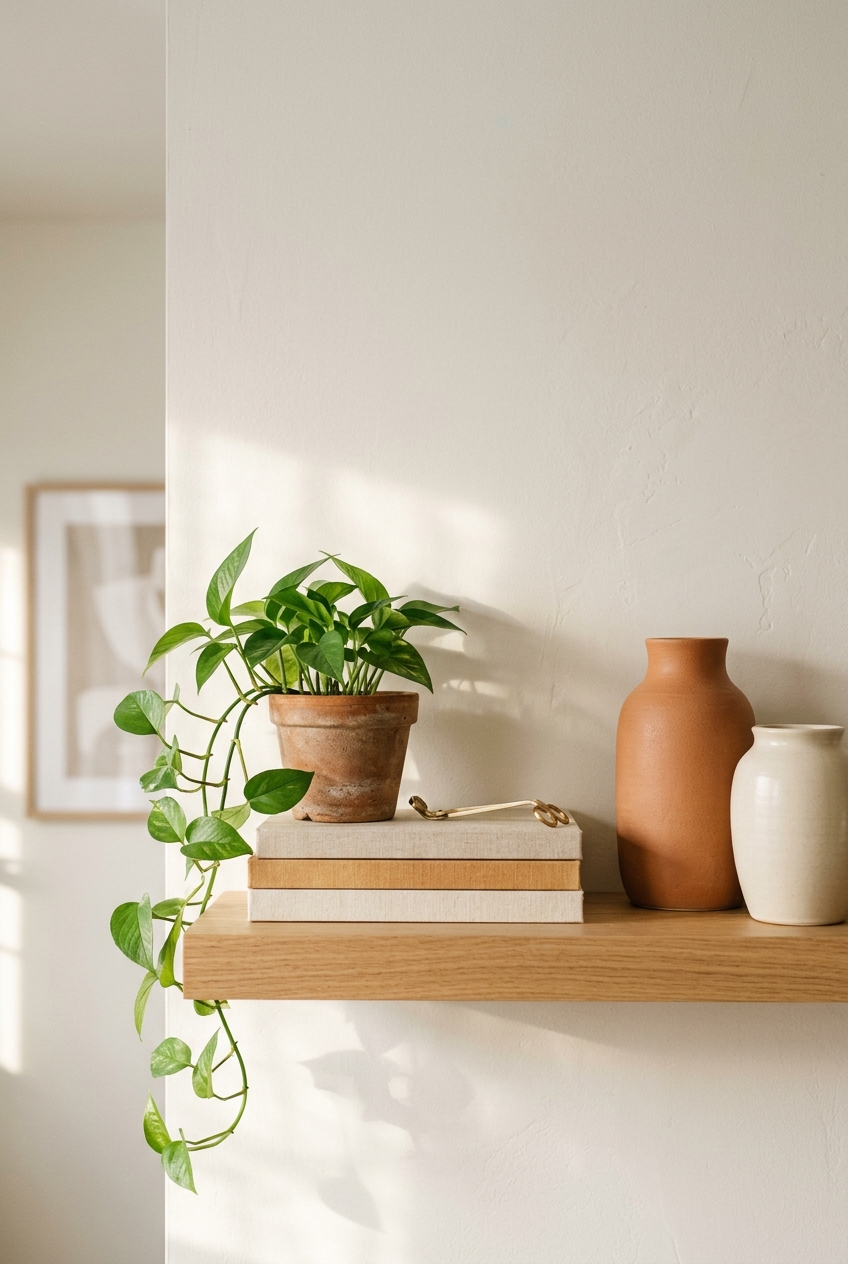
- Natural Elements/Greenery: Introduce life and softness with plants, dried flowers, or even a beautiful piece of driftwood. This category brings an organic touch and can break up the hard lines of books and shelves. A small Pothos plant in a simple ceramic pot, a preserved eucalyptus bunch, or a delicate air plant in a geometric holder are perfect examples. For a low-maintenance option, consider a faux plant from Crate & Barrel, ensuring it looks realistic.
The key is to mix and match. Don't put all your books on one shelf and all your decorative objects on another. Distribute them thoughtfully across your aesthetic shelf decor.
The "2" Heights: Dynamic Visual Flow
To avoid a flat, uninteresting display, incorporate at least two distinct height levels within each styled section of your aesthetic shelf decor. This creates visual dynamism and guides the eye. Varying heights adds a professional, layered look.
- Tall Elements: These draw the eye upwards and provide a backdrop. Examples include vertically stacked books, tall vases, larger sculptures, or framed artwork leaning against the back of the shelf. A 10-inch tall West Elm Reactive Glaze Vase or a stack of three coffee table books like "Architectural Digest at 100" would fit this category.
- Short/Medium Elements: These fill the middle ground and foreground, adding detail and grounding the display. Think horizontally stacked books, smaller decorative objects, candles, or small plants. A 4-inch tall Opalhouse Ceramic Decorative Bowl or a trio of Voluspa Macaron Candles fit this description.
You can achieve these height variations through several methods:
- Stacking: Use horizontally laid books as a pedestal for a smaller object.
- Layering: Place a smaller item in front of a taller one.
- Object choice: Simply select items of naturally different heights.
Aim for a pleasing "mountain range" effect – peaks and valleys – rather than a uniform skyline. This makes your aesthetic shelf decor much more engaging.
"Varying heights is not just about aesthetics; it's about creating a visual journey for the eye across your display."
The "1" Focal Point: Commanding Attention
Every styled section of your aesthetic shelf decor needs a clear focal point. This is the star of the show, the item that immediately draws the eye and anchors the arrangement. Without a focal point, the eye wanders aimlessly, and the display can feel chaotic. This focal point is often the largest or most visually striking item in that particular grouping.
Consider these options for your focal point:
- Artwork: A framed print or small painting leaning against the back of the shelf. Brands like Artfully Walls or Minted offer diverse options.
- Large Vase/Sculpture: A substantial, eye-catching piece. The Ferm Living Ripple Carafe can serve as a beautiful, functional focal point.
- Unique Collectible: A cherished travel souvenir or an antique object that tells a story.
- Statement Plant: A particularly lush or architectural plant. A small Snake Plant (Sansevieria trifasciata) in a modern planter can be very striking.
The focal point doesn't have to be expensive, but it should be visually significant. It's the anchor around which the other "3" types of objects and "2" heights are arranged. For instance, on a single shelf, you might have a framed print as your focal point, flanked by a stack of books and a small plant, with a decorative object nestled on top of the books. This creates a clear hierarchy and makes your aesthetic shelf decor feel intentional.
Applying the Rule: A Step-by-Step Guide
Ready to transform your shelves? Follow these steps to apply the 3-2-1 rule effectively for aesthetic shelf decor:
- Empty and Clean: Start with a blank slate. Remove everything from your shelves and give them a good wipe down. This allows you to envision the space afresh.
- Gather Your Inventory: Collect all the items you might want to display. Lay them out on a table or floor so you can see everything at once. Group similar items (books, decorative objects, plants).
- Define Your Sections: If you have a large bookcase, break it down into smaller, manageable sections. Each individual shelf, or sometimes two adjacent shelves, can be treated as its own "section" for applying the 3-2-1 rule.
- Place Your Focal Point (The "1"): For each section, select and place your primary focal point. This is often the largest or most impactful item. Position it slightly off-center for a more natural, less rigid look.
- Introduce Tall Elements (Part of the "2"): Next, add your taller items around the focal point. This could be vertical stacks of books, a tall vase, or a larger plant. Ensure these elements complement the focal point without overwhelming it.
- Incorporate Shorter Elements (The other "2"): Fill in the gaps with shorter objects. Use horizontal book stacks, smaller decorative items, or candles. Remember to vary heights here too, perhaps by placing a small bowl on top of a book stack.
- Mix Your Object Types (The "3"): As you place items, ensure you're incorporating books, sculptural/decorative objects, and natural elements within each section. Don't be afraid to combine them – a small plant next to a vertical book stack, with a decorative box on top of a horizontal stack.
- Step Back and Edit: This is crucial. Once you've placed everything, step back and look at the entire shelf or bookcase. Does it feel balanced? Is there enough negative space? Remove anything that feels redundant or creates clutter. Sometimes, less is more.
- Refine and Adjust: Tweak placements. Shift items an inch to the left or right. Experiment with different groupings. Play with asymmetry. Good styling is often about subtle adjustments. You might find that moving a small object from one side of a book stack to the other completely changes the feel.
Here's a quick comparison of a cluttered vs. curated shelf:
| Cluttered Shelf (Before) | Curated Shelf (After 3-2-1 Rule) |
|---|---|
| All items are roughly the same height. | Clear variation in height (tall books, medium vase, short candle). |
| Only books or only decorative items. | Mix of books, a ceramic vase, and a small Pothos plant. |
| No clear point of interest. | A framed abstract print serves as the focal point. |
| Items placed randomly. | Items grouped thoughtfully, creating small vignettes. |
| Feels overwhelming and disorganized. | Feels balanced, intentional, and visually appealing. |
Common Mistakes to Avoid When Styling Shelves
Even with the 3-2-1 rule, it's easy to fall into common styling traps. Being aware of these can help you achieve truly aesthetic shelf decor:
- Over-stuffing: The biggest culprit. Too many items make shelves look messy, not curated. Leave some breathing room (negative space) around your groupings. Not every square inch needs to be filled.
- Lack of Variety: Using only books or only small trinkets creates a flat, uninteresting display. Remember the "3" types of objects.
- Ignoring Scale: Placing tiny objects on vast shelves or huge items on narrow shelves looks awkward. Ensure your items are proportionate to the shelf size and each other. For example, a delicate 2-inch figurine will get lost next to a 12-inch heavy vase.
- Too Much Symmetry: While balance is important, perfect symmetry can feel stiff and unnatural. Embrace asymmetry for a more dynamic and organic look. For example, don't mirror every item on either side of a central object.
- Forgetting Texture: A display solely of smooth, shiny objects lacks warmth. Introduce different textures like rough wood, soft fabric, porous ceramic, or the crinkly pages of an old book.
- Neglecting Depth: Don't line everything up perfectly at the front of the shelf. Push some items further back, pull others forward, and layer smaller items in front of taller ones to create depth.
- Ignoring the Background: If your shelves are against a busy wallpaper or a brightly painted wall, choose simpler, more muted items to avoid visual overload. Conversely, a plain wall might benefit from more intricate objects or a piece of art as a focal point.
By actively avoiding these pitfalls, you can enhance the effectiveness of the 3-2-1 rule and ensure your aesthetic shelf decor consistently looks polished and intentional.
FAQ: Aesthetic Shelf Decor
How do I make my shelves look expensive?
Focus on quality over quantity. Choose fewer, well-made items. Incorporate natural materials like marble, brass, and solid wood. Opt for neutral palettes with pops of rich color. Use consistent finishes for frames and metals. Source unique pieces from local artisans or antique shops rather than mass-produced decor. The 3-2-1 rule helps you display these quality items effectively.
What should I put on open shelves?
Open shelves are perfect for displaying items you love and use often, but in a curated way. Think functional items like cookbooks, beautiful ceramics, glassware, or small bowls for keys, alongside decorative elements like small plants, framed photos, or sculptural objects. Always consider the "3" types of objects: books, decorative items, and natural elements.
How do I style a large bookcase?
Treat a large bookcase as a collection of smaller vignettes. Apply the 3-2-1 rule to each individual shelf or pair of shelves. Don't feel pressured to fill every space. Alternate between vertical and horizontal book stacks. Use larger focal points on some shelves to anchor the overall design. Ensure there's a good flow of color and height variations across the entire unit.
What is the rule of three in decorating?
The "rule of three" in general decorating suggests that objects grouped in odd numbers (especially three) are more visually appealing and memorable than even groupings. For aesthetic shelf decor, our 3-2-1 rule is a specific application of this concept, extending it to object types, heights, and focal points for a more comprehensive approach to shelf styling.
Should all my shelf decor be the same color?
No, a monochromatic scheme can feel flat. Introduce a cohesive color palette (e.g., 2-3 main colors plus neutrals) to add interest without creating chaos. Varying shades of the same color, or using complementary colors, works well. For example, warm neutrals with pops of sage green and a hint of brass.
How do I incorporate personal items without clutter?
Select only your favorite, most meaningful personal items. Group small collections together. Use books or decorative boxes to elevate smaller mementos. Frame photos in consistent frames. Integrate them within your 3-2-1 groupings – a cherished souvenir could be your "1" focal point, or a small collection of antique postcards could be a "decorative object."
Final Verdict
The 3-2-1 rule is the most effective framework for achieving aesthetic shelf decor. By consciously selecting three types of objects, incorporating two distinct heights, and establishing one clear focal point per styled section, you can transform any shelf from cluttered to curated. This method provides a clear, actionable path to creating balanced, visually interesting, and professionally styled displays that reflect your personal taste. Start applying it, and watch your shelves come to life.